Recent data from the STAR detector at the Relativistic Heavy Ion Collider (RHIC) indicate that gluons, the adhesive particles binding quarks within protons, are crucial for upholding baryon number, a fundamental aspect of a particle’s quantum identity. The research was published in Science.
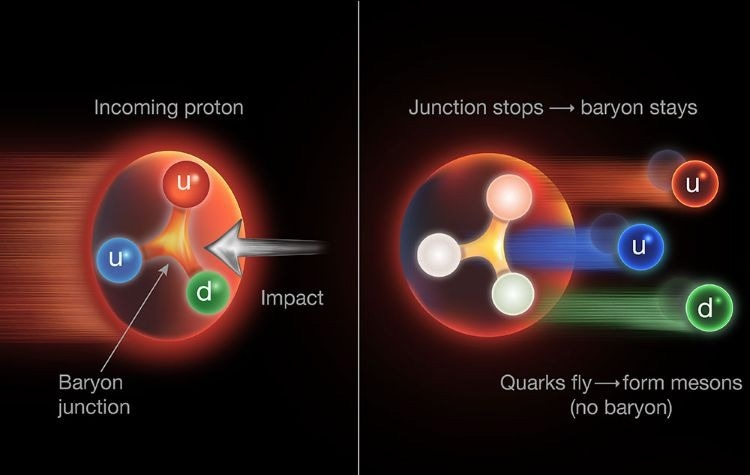 This image shows how, upon impact in a collision (left), a proton's three valence quarks (u, u, d) will continue to fly down the beampipe while the baryon junction, the Y-shaped configuration of gluons, is more easily stopped (right). The baryon junction will pull three new quarks out of the vacuum to become a new baryon, thus retaining the baryon number, while the "freed" quarks will each pair up with a new partner to form mesons. Image Credit: Valerie A. Lentz/Brookhaven National Laboratory
Observations from high-energy particle impacts at RHIC, a U.S. Department of Energy (DOE) Office of Science user facility for nuclear physics research, operational at DOE’s Brookhaven National Laboratory from 2000 to early 2026, imply that a Y-shaped gluon “junction” linking the proton’s three primary quarks transports baryon number. This research disputes the long-standing belief that only these three quarks bear baryon number.
“Traditionally, scientists have assumed that each of the three main ‘valence’ quarks inside a proton or neutron carries one-third of the baryon number,” says Zhangbu Xu, a professor at Kent State University with a joint appointment at Brookhaven Lab.
Physicists in the 1970s theorized the baryon junction, also known as the gluon junction, to explain how gluons bind those valence quarks inside protons. Subsequently, in 1996, four years prior to RHIC’s activation, Dmitri Kharzeev, a theoretical physicist affiliated with Stony Brook University and Brookhaven Lab, put forth the notion that the baryon junction might serve as the actual carrier of baryon number, rather than the valence quarks. In their study, the STAR team details a novel approach to investigating this concept.
Using data collected from different types of particle collisions at RHIC, our results suggest that the baryon number is not simply carried by individual quarks. Our findings strongly support the idea that baryon number is more favorably carried and transported by gluons, the particles that hold quarks together, when arranged in this special configuration.
Zhangbu Xu, Professor, Kent State University
Baryon Number Conservation
Identifying what carries baryon number has major consequences. Within RHIC collision events, the preservation of baryon number guarantees that the overall count of baryons, which are three-quark particles like protons and neutrons, stays constant pre- and post-collision. However, the principle of baryon number conservation applies universally across the universe.
“Since the Big Bang, the number of protons and neutrons all together never changes as a function of time,” notes Nicole Lewis, a STAR physicist at Rice University who started this project as a postdoc at Brookhaven Lab in 2020. “The reasons for this conservation are not well understood. It’s one of the mysteries of the universe, related to why we have more matter than antimatter,” she said.
From a practical, daily perspective, baryon number conservation accounts for the remarkable stability of protons, key constituents of atomic nuclei, preventing their decay.
It’s believed that the lifetime of a proton is longer than the lifespan of the universe. This allows atomic nuclei to form and be stable – which means matter, as we interact with it in the universe, can exist.
Nicole Lewis, STAR Physicist, Rice University
Excess Baryons
The notion that gluons possess baryon number challenges the established understanding of how this quantum characteristic is preserved. Most academic texts assert that a proton's baryon number of positive one is evenly distributed among its three primary valence quarks, with each quark holding a positive one-third baryon number. This parallels how electric charge is allocated among a proton's three valence quarks.
“In the naïve quark model, there are three quarks inside a proton, but nothing else. But if we look at details inside, there are not only three quarks but also a lot of gluons interacting, connecting between those quarks, and there are also quarks and antiquarks that pop up from the vacuum, so it’s actually a really complex object,” said Tommy Tsang, formerly a postdoc at Kent State University, now at DOE's Argonne National Laboratory.
The theoretical framework developed to explain this intricate arrangement, known as quantum chromodynamics (QCD), has proven highly effective in describing the "strong force" mediated interactions between quarks and gluons. Nevertheless, models derived from QCD often require additional assumptions to explain observations of particles streaming from RHIC's collisions of nuclei accelerated near light speed.
In the STAR detector, we consistently see an excess of baryons coming out of the collisions perpendicular to the direction of the colliding beams. The fact that we end up with more baryons than antibaryons – or more matter than antimatter – is not surprising since our collisions start with matter.
Tommy Tsang, Argonne National Laboratory
These high-energy impacts release a tremendous quantity of energy, which is converted into the formation of thousands of new particles.
However, detecting a baryon surplus, or net baryon number, in particles emerging away from the beamline prompted the STAR team to question the premise that valence quarks are solely responsible for carrying the baryon number.
To generate the observed surplus, it would demand that all three quarks of a single colliding proton "stop" and undergo a transformation from matter to energy and then back to matter in the detector's center, with all those newly formed baryons dispersing outward from the beamline.
Comparison with Charges
STAR researchers used the fact that valence quarks carry electric charge to investigate these events. They contrasted the net baryon counts recorded during various RHIC nuclear collisions against the electric charge reallocation within those identical impacts.
“Measuring the electric charge coming out perpendicular to the collision gives you a definitive way of measuring how many quarks are stopped and transformed into new particles,” said Zebo Tang, a professor at the University of Science and Technology of China who led a group of students performing data analyses and model simulations.
Investigators identified twice the baryon quantity expected from electric charges derived from stopped quarks. Consequently, based on QCD-based simulations, insufficient quarks are being stopped to generate the detected baryons.
Where do these surplus baryons originate? According to STAR experts, the solution might involve gluons, particularly the triple-junction gluon structure that typically binds valence quarks together.
Baryon Junction Transformation and Transportation
The STAR group reports that during RHIC proton-nucleus impacts, the "baryon junction" or "gluon junction" linking quarks halts far more readily than the trio of quarks; its entire energy converts into fresh baryons ejected laterally, whereas the quarks it formerly tethered proceed along the beampipe.
Visualizing the interior of protons moving near light speed clarifies this decoupling phenomenon.
“The baryon junction is always there even as protons are accelerated to higher and higher energy,” Prithwish Tribedy, a STAR physicist at Brookhaven Lab. “But at high energy, gluons within the proton split and multiply.”
As gluon density increases, every specific gluon, encompassing those forming the junction, possesses a diminishing portion of the proton’s total momentum, whereas the valence quarks, which remain, maintain the majority of the proton’s forward thrust. Consequently, during the collision moment, the slower three-pronged gluon configuration ought to be simpler to halt and convert into fresh particles compared to the rapid quarks.
Tribedy explained that halting one entity, the junction, rather than three separate quarks increases the probability of such interactions. “In the collision, the baryon junction gets held behind and the quarks continue on,” he noted.
Since quarks and gluons are unable to persist independently, these components rapidly pair with fresh particles. In a simplified scenario, every quark traversing the beampipe could combine with an antiquark, creating two-quark mesons, whereas the three-way gluon vertex, acting as a Y-shaped magnet, draws three additional quarks from the vacuum, forming a new baryon.
In fact, this conversion process is far more intense.
“Even though we start with nuclei that contain roughly 100 protons and 100 neutrons, these collisions create thousands of new particles; 99% of the energy is transformed into new particles,” said Rongrong Ma, a Brookhaven Lab physicist.
Increased particle production within a collision correlates with a larger observed surplus of “midrapidity” baryons, exceeding predictions derived from the simplistic model where quarks function as the exclusive baryon number carriers.
Evidence showing that numerous generated baryons appear orthogonal to the beamline offers strong validation for the baryon junction’s reality.
“Our research challenges the long-held idea that baryon number is simply divided among and carried by the three quarks,” said Ma. “This new understanding reshapes how we think about the structure of matter and deepens our knowledge of the most fundamental element that is responsible for the universe in its current form.”
Funding for this project originated from the DOE Office of Science, the U.S. National Science Foundation (NSF), plus various global entities and groups. Beyond using the Open Science Grid, which receives direct NSF backing, the team used processing assets at Brookhaven Lab’s Scientific Data and Computing Facilities and the National Energy Research Scientific Computing Center (NERSC), an additional DOE Office of Science user site at the Lawrence Berkeley National Laboratory.
Journal Reference:
Aboona, B. E., et al. (2026). Tracking the baryon number with nuclear collisions. Science. DOI:10.1126/science.ads5962. https://www.science.org/doi/10.1126/science.ads5962.