An international team of researchers has succeeded in producing atomic quantum gas mixtures with an unprecedented particle flux. In the journal Nature Communications, the scientists report on experiments conducted with the MAIUS-B apparatus, in which Bose–Einstein condensates (BECs) consisting of two different atomic species – rubidium and potassium – were generated and studied under microgravity conditions in the Einstein Elevator at Leibniz University Hannover, Germany.
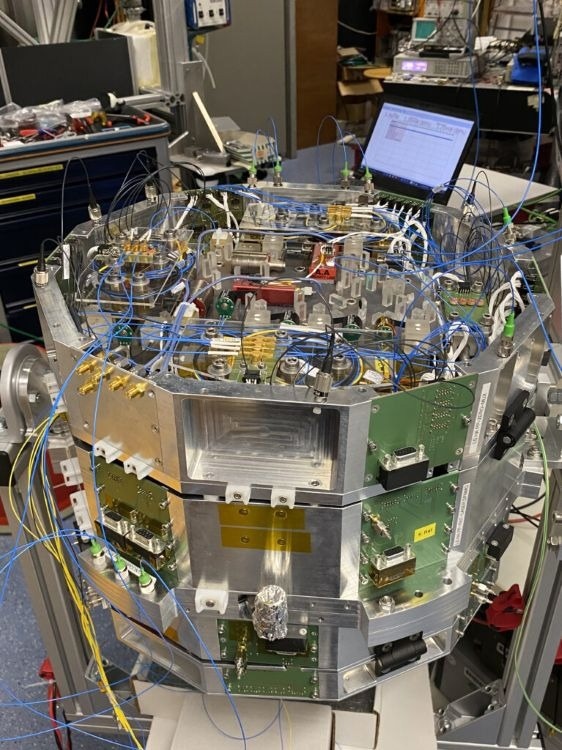 The miniaturized laser system, developed with major contributions from researchers at Johannes Gutenberg University Mainz. Image Credit: © Sören Boles
A key contribution to this achievement came from a technological development at Johannes Gutenberg University Mainz (JGU): the highly sophisticated and compact optical system used to control the atoms.
Technology As a Key to Success
Bose-Einstein condensates are considered an "exotic" state of matter that exists near absolute zero temperature, where quantum mechanical phenomena become observable on a macroscopic scale. While the generation of a BEC from a single atomic species was first achieved in space during the MAIUS-1 mission in 2017, simultaneously cooling and manipulating two different atomic species presented the researchers with enormous technological challenges.
To meet these challenges, the Mainz research group led by Professor Patrick Windpassinger and Dr. André Wenzlawski from the Institute of Physics at JGU developed a miniaturized laser system in collaboration with Humboldt-Universität zu Berlin and the Ferdinand-Braun-Institut, Berlin. Despite requiring twice as many lasers as well as additional optical and electronic components, the system maintained almost the same payload volume and mass. "Our task was to develop the optical interfaces between the laser modules and the vacuum system, that are essential for cooling and manipulating the atoms," explained Wenzlawski.
A central technological component of the system is the set of optical benches, which form the interface between the laser modules and the vacuum system. These were developed jointly by JGU and the University of Hamburg. The optical benches are based on the glass-ceramic material Zerodur, which is characterized by an exceptionally low coefficient of thermal expansion. "This stability is crucial for maintaining precise control of the atoms under the extreme mechanical loads of a rocket launch and varying temperature conditions," said Wenzlawski.
The long-term operation of the apparatus in the Einstein Elevator and in laboratory environments has validated the technological concept. The system achieves the atomic flux reported to date for such a dual-species BEC mixture, outperforming existing mobile systems by an order of magnitude.
Pioneering Technology for Future Space Missions
The technologies developed in Mainz represent a major milestone in the use of quantum sensors in space. The robustness and precision of the optical modules provide the foundation for future flagship projects such as the German-American BECCAL atom laboratory aboard the International Space Station (ISS). Systems of this kind will enable scientists to test Einstein's equivalence principle with unprecedented precision by measuring whether different atomic species experience exactly the same acceleration during free fall.
The QUANTUS IV – MAIUS project was coordinated by the Center of Applied Space Technology and Microgravity (ZARM) in Bremen and funded by the German Space Agency at German Aerospace Center (DLR).