Graphene has long been recognized as one of the most promising materials for future electronics, but its low electron interactions have hampered its use in high-temperature superconductors. Tohoku University researchers have now tackled a significant challenge by forming a stable version of the long-sought "boron graphene" on the top of a three-dimensional crystal, unveiling a new quantum state that might lead to more energy-efficient electronic gadgets. The results were published in Science Advances.
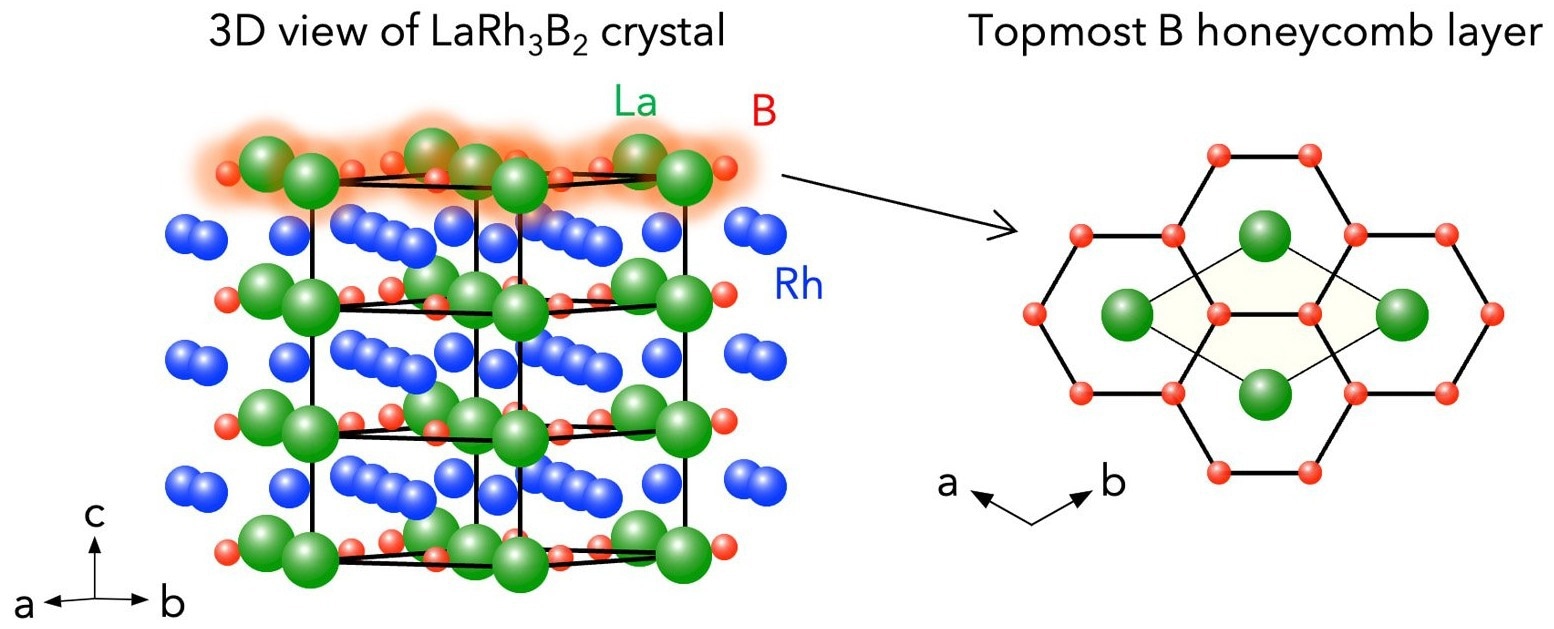 3D view of the crystal structure of LaRh3B2 (left) and the top view of the LaB honeycomb layer exposed at the surface (right). Image Credit: ©T. Kato et al.
We demonstrated a fundamentally new way of creating two-dimensional quantum materials. Rather than attempting to produce an unstable free-standing sheet of boron atoms, we exposed a naturally occurring honeycomb boron layer that already exists within a stable three-dimensional crystal called LaRh3B2.
Takafumi Sato, Advanced Institute for Materials Research (WPI-AIMR), Tohoku University
For years, researchers have been intrigued by borophene, a two-dimensional sheet of boron atoms, since its stronger electron interactions might result in strange quantum phenomena not seen in graphene. But the optimal honeycomb structure of borophene is so unstable that it is nearly impossible to produce.
Sato and his associates adopted a different strategy rather than attempting to directly synthesize borophene. They employed the crystal structure of LaRh3B2, which naturally has layers of boron atoms organized in a honeycomb arrangement. They produced a stable two-dimensional electrical system with the characteristics of the elusive substance by exposing these layers at the crystal's surface.
The group discovered an exceptionally high concentration of electrons close to the material's Fermi level using angle-resolved photoemission spectroscopy (ARPES) at synchrotron radiation facilities. This characteristic, called a van Hove singularity, is significant because it may generate unexpected quantum behavior and significantly enhance electron interactions.
The scientists were able to view the electrons in real space by combining these data with scanning tunneling microscopy and spectroscopy (STM/STS). When the two methods were combined, they demonstrated how the electrons spontaneously aligned in a single preferred orientation, disrupting the crystal's initial six-fold symmetry and creating an "electronic nematic state", a quantum condition where electrons behave like molecules in a liquid crystal display.
Instead of struggling to synthesize a fragile two-dimensional boron sheet from scratch, we looked inside a stable three-dimensional crystal that already contained a boron honeycomb lattice and exposed it on the material's surface. Observing this electronic liquid crystal state in a graphene-like material shows that carefully designing a material's electronic structure can unlock entirely new quantum phenomena.
Takafumi Sato, Advanced Institute for Materials Research (WPI-AIMR), Tohoku University
Combining real-space and momentum-space imaging methods was a crucial component of the finding. While STM directly saw the subsequent symmetry-breaking electronic pattern, ARPES indicated an electronic "hot spot" where the instability may arise. The researchers explained the formation of the electronic nematic state by comparing the two sets of observations.
Neither technique alone could have revealed the full picture. By combining momentum-space information from ARPES with real-space observations from STM, we were able to connect the electronic instability with the emergence of the nematic state. This synergy was essential to understanding the physics behind this new quantum phase.
Kosuke Nakayama, Assistant Professor, Graduate School of Science, Tohoku University
Researchers can easily modify the quantity and behavior of electrons within the material because the crystal family employed in this study permits the substitution of many of its chemical constituents. This adaptability offers a strong foundation for creating novel quantum materials and may hasten the creation of energy-efficient quantum devices and next-generation superconductors.
Download the PDF of this page here
Journal Reference:
Kato, T., et al. (2026) Realization of strongly correlated 2D honeycomb boron. Science Advances. DOI: 10.1126/sciadv.aee3116. https://www.science.org/doi/10.1126/sciadv.aee3116.