The first experimental demonstration of KPZ behavior on 2D surfaces in space and time has been accomplished by a research team from the Cluster of Excellence ctd.qmat, located in Würzburg. Polaritons, which are hybrid particles formed of matter and light, were injected into the material by researchers using a daring experimental strategy and advanced materials engineering. The findings were released in the journal Science.
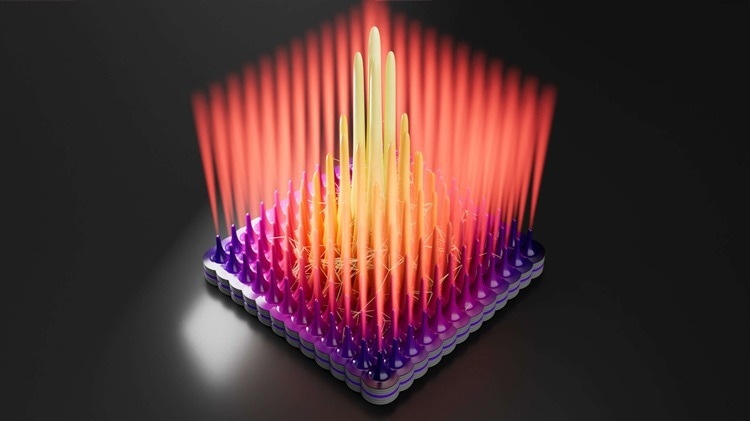
This rendering shows a GaAs-based semiconductor sample approximately 20 micrometers in size. Following laser excitation, polaritons form within the central (purple) layer and exit the quantum system after a few picoseconds as light with a different wavelength, visible as a diffuse red glow at the edges. Mirror layers positioned above and below the purple region reflect the polaritons, allowing their positions to be tracked across both space and time. The image illustrates spatial correlations within the quantum system, represented by the height of the towers and the white connecting lines. Using this experimental setup, researchers from the Würzburg Cluster of Excellence ctd.qmat have, for the first time, demonstrated KPZ universality in a two-dimensional system across both space and time. Image Credit: © think-design | Jochen Thamm
The Kardar–Parisi–Zhang equation was first used in the 1980s to describe surface growth, including crystals, bacterial colonies, and flame fronts. Since then, it has come to be recognized as a foundational concept in physics, with applications in computer science, biology, and mathematics.
Forty Years of Universality in Growth
One of the most fundamental questions in physics is how surfaces grow. With the Kardar–Parisi–Zhang (KPZ) equation, three physicists established the groundwork for a universal theory of growth in 1986. This framework has numerous applications in computer science, physics, mathematics, and biology. The KPZ universality class is applicable wherever growth processes are described, from the dynamics of crystal formation and mathematical system analysis to the growth of cells, populations, and flame fronts, even the creation of machine-learning algorithms.
Following the model's initial experimental confirmation for one-dimensional systems based on polaritons in 2022, a Würzburg research team has now retested this potent framework in the lab, providing the first experimental demonstration for two-dimensional systems and interfaces in history.
Würzburg Research Team Achieves Breakthrough in 2D Quantum System
When surfaces grow – whether crystals, bacteria, or flame fronts – the process is always nonlinear and random. In physics, we describe such systems as being out of equilibrium.
Siddhartha Dam, Postdoctoral Researcher, Würzburg–Dresden Cluster of Excellence ctd.qmat
Siddhartha Dam, also the Chair of Technical Physics at the University of Würzburg, notes, “Engineering a system capable of simultaneously measuring how a non-equilibrium process evolves in space and time is extremely challenging – especially because these processes unfold on ultrashort timescales. That’s why verifying the KPZ model in two dimensions has taken so long. We have now succeeded in controlling a non-equilibrium quantum system in the laboratory – something that has only recently become technically feasible.”
To accomplish this, the researchers continually stimulated a semiconductor sample made of gallium arsenide (GaAs) using a laser while cooling it to −269.15 °C. Polaritons, which are hybrid particles composed of photons (light) and excitons (matter), were created inside a particular layer of the structure through careful materials engineering.
Only non-equilibrium conditions allow polaritons to exist; they are produced by laser stimulation and decay in a matter of picoseconds before exiting the system.
We can precisely track where the polaritons are in the material. When we pump the system with light, polaritons are created – they grow. Using advanced experimental techniques, we were able to quantify both the spatial and temporal evolution of this growing quantum system and found that it follows the KPZ model.
Siddhartha Dam, Postdoctoral Researcher, Würzburg–Dresden Cluster of Excellence ctd.qmat
Sebastian Diehl, a professor at the Institute for Theoretical Physics at the University of Cologne and a member of the research team, developed the central concept: testing a universal theory of growth within a quantum system using polaritons (quasiparticles that exist only within a highly dynamic growth process).
The theoretical groundwork for this approach was established in 2015. In 2022, a research team in Paris provided the first experimental evidence of KPZ behavior, although their results were limited to a one-dimensional system.
Diehl remarks on the accomplishment of the Würzburg team, saying, "The experimental demonstration of KPZ universality in two-dimensional material systems highlights just how fundamental this equation is for real non-equilibrium systems."
Targeted Materials Design Enables Injection of Polaritons
The researchers created an extremely intricate sample structure in order to introduce polaritons into the material. Photons are contained within a central "quantum film" layer by mirror layers, where they can couple with excitons in the gallium arsenide to produce polaritons, grow, and be assessed.
By precisely controlling the thickness of individual material layers using molecular beam epitaxy, we were able to tune their optical properties and hence fabricate the necessary highly reflective mirrors under ultra-high vacuum conditions.
Simon Widmann, Doctoral Researcher, Chair of Engineering Physics
Simon Widmann, who conducted the experiments together with Siddhartha Dam, adds, “We control how the material grows atom by atom and can fine-tune all experimental parameters – for example, the laser, which must excite the sample with micrometer precision. This level of control was essential for successfully demonstrating KPZ universality.”
Download the PDF of this page here
Journal Reference:
Widmann, S., et al. (2026). Observation of Kardar-Parisi-Zhang universal scaling in two dimensions. Science. DOI: 10.1126/science.aeb4154. https://www.science.org/doi/10.1126/science.aeb4154.