Under the direction of Prof. Dr. Tim Schröder, a research team from the Joint Lab Diamond Nanophotonics at the Ferdinand-Braun-Institut (FBH) in Berlin and the Integrated Quantum Photonics working group at the Department of Physics at Humboldt University of Berlin has now successfully applied the novel SUPER (Swing-UP of the quantum EmitteR population) method. Results of the study were recently published in the journal Nature Communications.
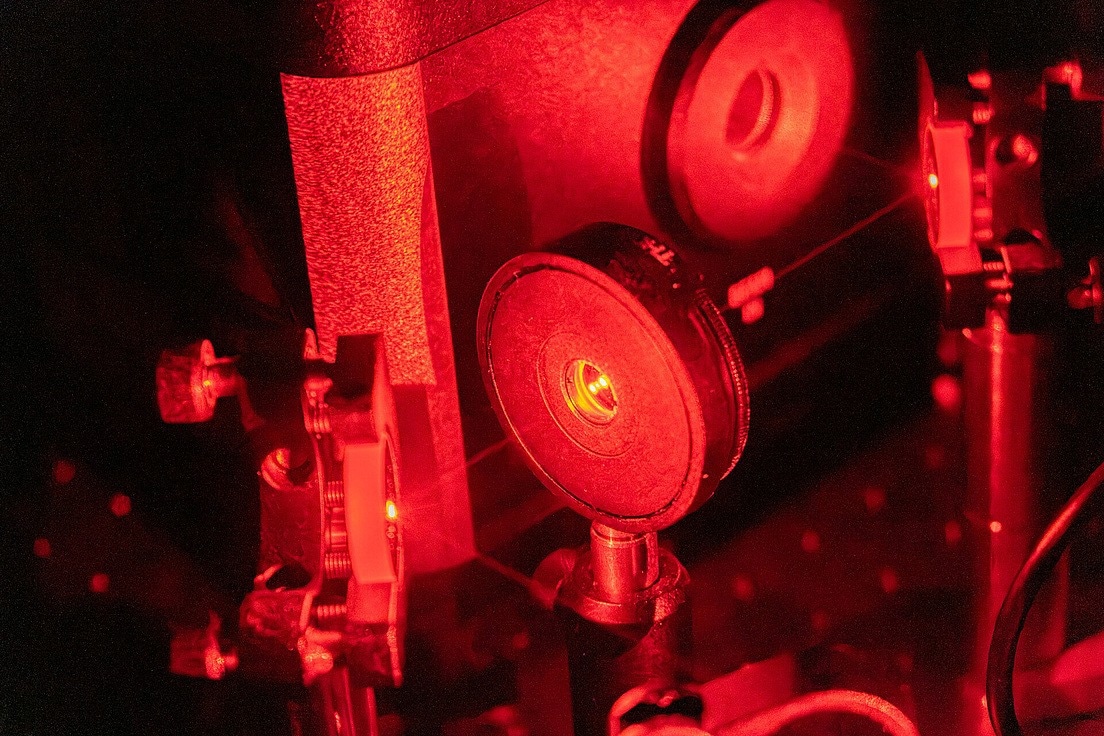 Image Credit: Stefan Klenke/Humboldt University of Berlin
Many applications of quantum technology, including quantum networks and quantum computing, depend on the controlled production of single photons.
The method makes it easier to produce light particles (photons) under regulated conditions.
New SUPER Method Renders Photon Generation More Efficient
The research focuses on diamond crystals with particular flaws in their atomic structure, known as tin vacancy centers (SnV centers) or color centers. These atomic structures function as stable quantum bits (qubits), storing and processing quantum information before coupling it to light particles.
Controlling these qubits with light, while also reliably detecting the photons they produce as information carriers, has remained a major barrier in quantum technology so far. Conventional methods frequently depend on intricate filtering procedures that limit the system's scalability for real-world applications and lower efficiency.
Working with Prof. Doris Reiter and Dr. Thomas Bracht from TU Dortmund University, the research team has shown that this challenge can be addressed using the novel SUPER approach, co-developed by their Dortmund colleagues. SUPER relies on two carefully tuned laser pulses (control lasers) to excite the quantum system.
This makes it much easier to distinguish the control laser from the individual photons carrying the quantum information. The researchers used exceedingly brief laser pulses to manipulate the qubits. These pulses work at femtoseconds (one quadrillionth of a second) and are among the quickest optical control operations yet achieved for diamond-based quantum systems.
Ultrafast Laser Pulses Improve Control over the Quantum State
With ultrafast pulses, we can control the quantum state on completely new time scales. This opens the door to faster and more complex quantum operations in diamond.
Cem Güney Torun, Study Lead Author and Doctoral Student, Department of Physics, Humboldt University of Berlin
Mustafa Gökçe, also a lead author and former research assistant at the Department of Physics, added, “Our method enables us to efficiently excite the system while keeping the emitted single photons clean and usable. That is a key requirement for building practical networks for quantum communication.”
Another key observation is that the SUPER approach retains the system's inherent quantum spin state. This ability is critical for creating quantum entanglement between distant nodes, which is another key component of future quantum communication networks.
Combination of Nanofabrication, Ultrafast Optics, and Modelling Enables New Insights
The quantum researchers used a variety of experimental methodologies for the investigation, including diamond nanostructure production with embedded tin vacancy centers, ultrafast optical technologies, and theoretical modeling.
This combination allowed the scientists to demonstrate that SUPER is an effective new tool for solid-state quantum technologies. The findings move diamond-based quantum repeaters and distributed quantum computers one step closer to practical use.
Sources:
Journal Reference:
Torun, C. G. et al. (2026) SUPER and femtosecond spin-conserving coherent excitation of a tin-vacancy color center in diamond. Nature Communications. DOI: 10.1038/s41467-026-69911-1. https://www.nature.com/articles/s41467-026-69911-1.
Humboldt University of Berlin