A new study, appearing in The Astrophysical Journal and based on observations from NASA's Chandra X-ray Observatory, challenges the prevailing understanding that almost all galaxies harbor a supermassive black hole at their center. Contrary to the common belief, the research, conducted by an international team including a Penn State researcher, found that most smaller galaxies may not possess these central, massive black holes.
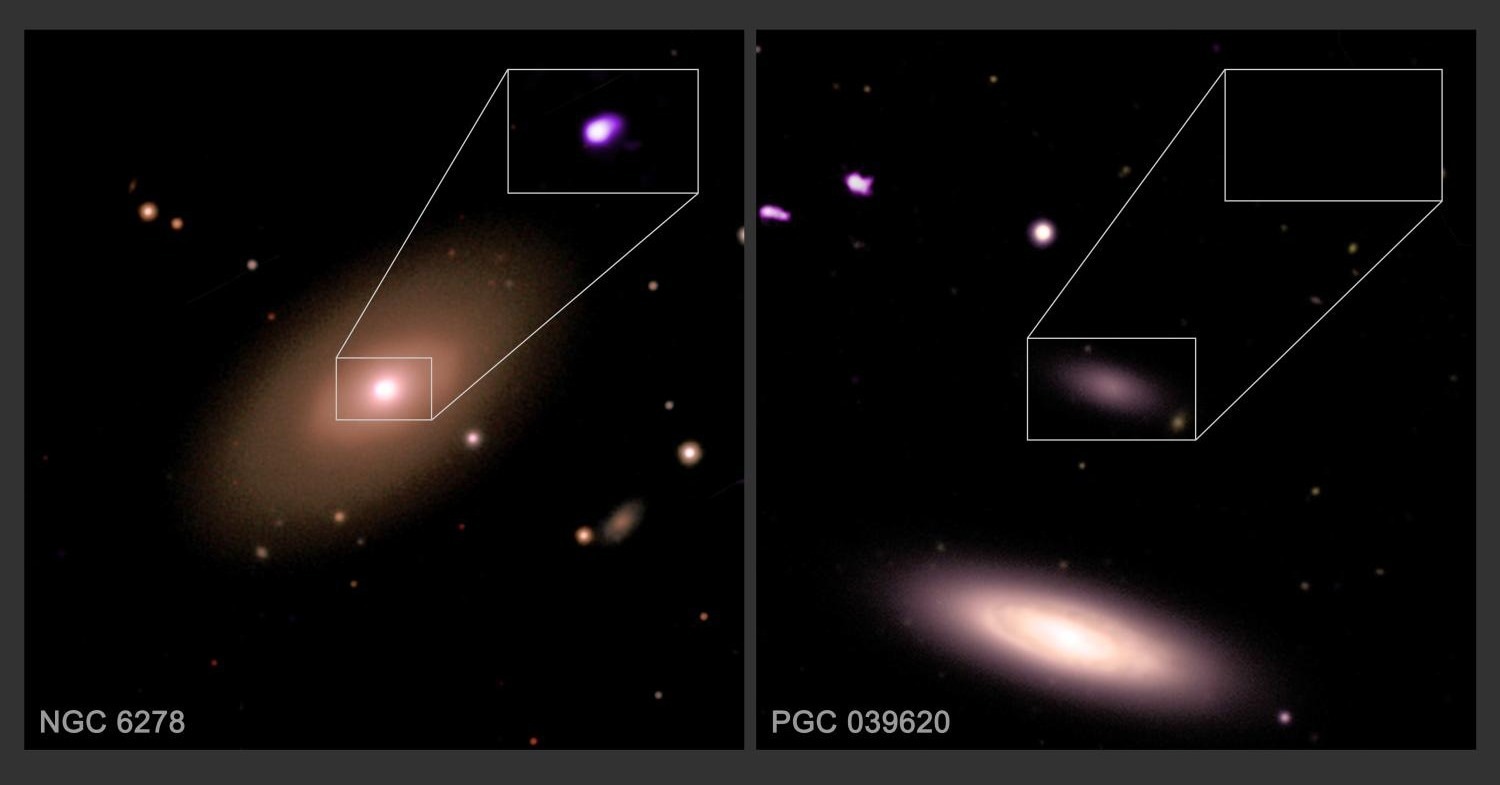 A new study analyzed over 1,600 galaxies observed with NASA’s Chandra X-ray Observatory over two decades and suggests that smaller galaxies do not contain supermassive black holes nearly as often as larger galaxies do. The study indicates that most smaller galaxies like PGC 03620, right, shown here in both X-rays from Chandra and optical light images from the Sloan Digital Sky Survey, likely do not have supermassive black holes in their centers. In contrast, NGC 6278, left, which is roughly the same size as the Milky Way, and most other large galaxies in the sample show evidence for giant black holes within their cores. Image Credit: X-ray: NASA/CXC/SAO/F. Zou et al.; Optical: SDSS; Image Processing: NASA/CXC/SAO/N. Wolk.
The study includes data from over 1,600 galaxies gathered over more than twenty years by NASA’s Chandra X-ray Observatory. These galaxies varied from dwarf galaxies with stellar masses that are less than a few percent of the Milky Way to those with masses exceeding ten times that of the Milky Way. The researchers discovered that approximately 30 % of dwarf galaxies are likely to host supermassive black holes.
It’s important to get an accurate black hole head count in these smaller galaxies. It’s more than just bookkeeping. Our study gives clues about how supermassive black holes are born. It also provides crucial hints about how often black hole signatures in dwarf galaxies can be found with new or future telescopes.
Fan Zou, Study Lead and Postdoctoral Researcher, University of Michigan
Zou earned a doctoral degree at Penn State.
As material descends into black holes, it experiences heating due to friction, resulting in the emission of X-rays. Numerous massive galaxies examined in the study exhibit luminous X-ray sources at their cores, which serve as a definitive indication of the presence of supermassive black holes at their centers. The research team found that over 90% of massive galaxies, including those with masses similar to the Milky Way, contain supermassive black holes .
The smaller galaxies analyzed in the study typically lack these clear indicators of black holes. Galaxies with masses under three billion solar masses, roughly equivalent to the mass of the Large Magellanic Cloud (a neighboring galaxy to the Milky Way) generally do not possess bright X-ray sources at their centers.
Robustly establishing these results relied upon a much larger galaxy sample than used in previous work – about five times larger – as well as some impressive statistical methods. The steady advances over the past few decades in both generating large X-ray observation samples and tackling gnarly statistical inference challenges have, slowly but surely, been transformational for high-energy astrophysical discovery.
Niel Brandt, Study Author and Eberly Family Chair Professor, Astronomy and Astrophysics, Penn State
The researchers examined two potential explanations for the absence of X-ray sources. The first explanation suggests that the proportion of galaxies harboring massive black holes is significantly lower among these less massive galaxies. The second explanation posits that the X-rays generated by matter accreting onto these black holes are so weak that they remain undetectable by Chandra.
We think, based on our analysis of the Chandra data, that there really are fewer black holes in these smaller galaxies than in their larger counterparts.
Elena Gallo, Study Author and Professor, Astronomy, University of Michigan
The researchers examined both scenarios regarding the absence of X-ray sources in small galaxies within their extensive Chandra sample. The brightness or dimness of black holes in X-rays is influenced by the volume of gas that is accreted onto them.
The smaller black holes are anticipated to attract less gas compared to their larger counterparts; they are expected to be less luminous in X-rays and frequently undetectable. The researchers validated this hypothesis through their analysis.
The team discovered that less massive galaxies exhibit an additional shortfall of X-ray sources that surpasses the anticipated reduction due to the diminished gas inflow. This extra shortfall can be explained by the possibility that many of the low mass galaxies lack black holes at their centers.
The team's conclusion indicated that the decline in X-ray detections in lower mass galaxies signifies a genuine reduction in the number of black holes present in these galaxies.
The researchers noted that this discovery could have important implications for understanding how supermassive black holes form. There are two main theories: one proposes that a massive gas cloud collapses directly into a black hole, starting out with a mass thousands of times greater than the Sun. The other suggests that supermassive black holes grow over time through the accumulation and merging of much smaller black holes, which are created when massive stars collapse.
The formation of big black holes is expected to be rarer, in the sense that it occurs preferentially in the most massive galaxies being formed, so that would explain why we don't find black holes in all the smaller galaxies.
Anil Seth, Study Author and Professor, Physics and Astronomy, University of Utah
The researchers stated that this recent study reinforces the hypothesis that giant black holes are formed with an initial mass several thousand times greater than that of the Sun. The researchers indicated they would anticipate smaller galaxies to possess a similar proportion of black holes as their larger counterparts.
The study could also impact the rate of black hole mergers that occur due to the collisions of dwarf galaxies. Such mergers generate ripples in the fabric of space-time known as gravitational waves, which can be detected on Earth using specialized instruments like LIGO or the forthcoming Laser Interferometer Space Antenna. A significantly reduced number of black holes would lead to a diminished number of gravitational wave sources.
“Chandra is still working great for these kinds of observations and, if reliably funded, can keep building up the samples that underlie such fundamental cosmic insights,” Brandt said
The study received financial support from the National Aeronautics and Space Administration as well as the U.S. National Science Foundation.
Journal Reference:
Zou, F., et al. (2025) Central Massive Black Holes Are Not Ubiquitous in Local Low-mass Galaxies. The Astrophysical Journal. DOI 10.3847/1538-4357/ae06a1. https://iopscience.iop.org/article/10.3847/1538-4357/ae06a1