Light cones are among the most important geometric concepts in modern physics, providing a framework for describing the relationship between space, time, and the propagation of light. They define the boundaries within which events can influence or be observed from a given point in spacetime.
Image Credit: /Shutterstock.com
Hermann Minkowski introduced the geometric notion of the light cone as a consequence of Einstein’s special relativity. The concept has since outgrown its origins, now organizing thinking in quantum information science, cosmology, black hole physics, and condensed matter physics, wherever a finite propagation speed constrains how influence can spread.
What Is a Light Cone?
A light cone is a geometric representation of the causal structure of spacetime, showing which events can be connected by light or slower-than-light signals. It is typically visualized using a spacetime diagram, in which one spatial dimension is plotted along the horizontal axis and one time dimension along the vertical axis. The remaining spatial dimensions are omitted for simplicity.
An event represents a specific location at a specific moment in time, while the continuous path traced by an object through spacetime is called its worldline, meaning the worldline shows how an object moves through space and time relative to a chosen reference frame.
A flash of light emitted from a single event propagates outward at the speed of light. In a spacetime diagram, its path forms the boundaries of a cone, with light spreading through space as time progresses. This structure divides spacetime into distinct regions based on their possible connections to the original event.
The future light cone contains all events that can be reached by a light signal emitted from the original event, while the past light cone contains all events from which a light signal could have reached the original event. Events within these cones can therefore be connected to the original event by signals traveling at or below the speed of light.
Events outside both cones are classified as elsewhere, corresponding to space-like separated events. No light signal or slower-than-light influence can connect these events to the original event.1
The following figure illustrates this structure for a single event O.
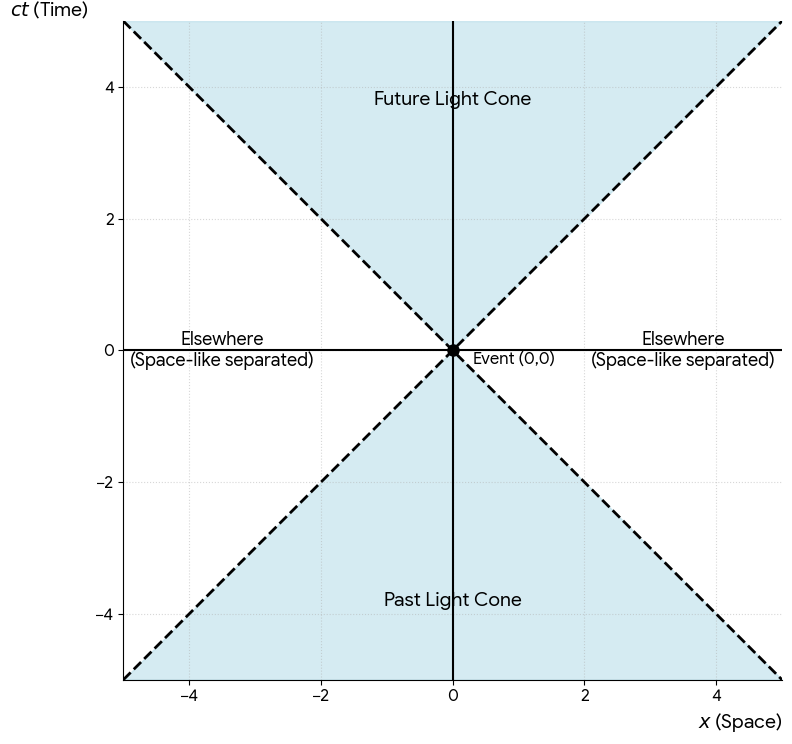
Figure 1. The light cone at event O, dividing spacetime into future, past, and elsewhere regions.
What Can We Learn From Light Cones?
Light cones provide a geometric framework for understanding causality in relativity, which describes how events can influence one another through space and time. Because information and physical influences cannot propagate faster than the speed of light in a vacuum, an event can only causally affect events within its future light cone. As a consequence, a cause must precede its effect, and the light-cone structure makes this causal ordering explicit.
The separation between two events can be classified according to their position relative to the light cone:
- Time-like intervals: The events lie within each other’s light cones, allowing a slower-than-light signal to travel between them. Their temporal order is preserved for all observers.
- Light-like intervals: The events lie exactly on the light-cone boundary and can be connected only by a signal traveling at the speed of light.
- Space-like intervals: The events lie outside each other’s light cones, meaning that no signal traveling at or below the speed of light can connect them. They therefore cannot have a direct causal relationship.
This structure also explains why superluminal communication is incompatible with relativity. A signal traveling faster than light would connect space-like separated events, allowing different observers moving relative to one another to disagree on which event occurred first.
Observers can disagree about the simultaneity of space-like separated events, but they agree on the causal ordering of time-like and light-like separated events.2,3
Light Cones in General Relativity
In general relativity, gravity is described as the curvature of spacetime caused by mass and energy. This curvature changes the orientation and shape of light cones from one location to another, altering the possible paths of light and matter.
In weak gravitational fields, these changes are small, but in strong gravitational fields they can substantially modify the local causal structure.
The effect becomes extreme near a black hole. In suitable coordinate systems, the future light cones appear to tilt inward closer to the event horizon. At the horizon itself, every future-directed path points into the black hole, so escaping would require moving outside the future light cone. Beyond the horizon, even light cannot escape, and all future-directed paths lead toward the central singularity.
The curvature of spacetime also produces gravitational lensing, in which light follows curved paths around massive objects, altering the apparent positions and shapes of distant sources. On cosmological scales, the expansion of the universe affects the structure of light cones and determines which distant events can ever be observed. An observer can receive information only from events whose past light cones intersect the observer's worldline, defining the observable universe.4
Light Cones and Quantum Physics
Light cones extend beyond classical relativity and provide a useful framework for understanding causality, correlations, and information flow in quantum systems. Several areas of modern physics use concepts analogous to or directly constrained by the relativistic light cone.
Quantum Field Theory
Quantum field theory is constructed to preserve relativistic causality. Quantum fields are defined at points throughout spacetime, and field operators associated with space-like separated events commute.
This condition, known as microcausality, ensures that operations performed at one location cannot instantaneously influence measurable outcomes at another space-like separated location. This means information cannot propagate outside the relativistic light cone.5
Quantum Entanglement
Quantum entanglement does not provide a mechanism for faster-than-light communication. Entangled particles can exhibit nonlocal correlations, meaning that measurements performed at widely separated locations can produce correlations that local classical theories cannot explain. However, the individual measurement outcomes remain unpredictable, so no usable information can be transmitted through the entanglement alone.
Bell experiments have experimentally demonstrated these nonlocal quantum correlations and ruled out broad classes of local hidden-variable theories, while remaining consistent with relativistic causality. The results therefore distinguish quantum nonlocality from superluminal signaling: entanglement can produce correlations across space-like separations without allowing information to travel outside the light cone.6,7
Lieb-Robinson Light Cones
Condensed matter physics introduces another form of light cone through the Lieb-Robinson bound, which describes how quickly information and correlations can spread through quantum systems with local interactions.
Unlike relativistic light cones, these are effective light cones with propagation speeds determined by the properties and interactions of the material rather than the speed of light.
Lieb-Robinson bounds are important in quantum simulators, quantum computers, and many-body physics, where they constrain how rapidly a local disturbance can influence distant parts of a system. They also help describe the spread of entanglement and the timescales associated with thermalization and information propagation.
While Lieb-Robinson light cones are not fundamental relativistic limits, they provide a similar organizing principle for information flow in quantum materials.6,7
Download the PDF of this page here
Applications in Modern Research
Light cones remain central to several active research areas that investigate the relationship between causality, quantum information, and the structure of spacetime. In relativistic quantum information, researchers study how entanglement and quantum communication behave for observers in relative motion or in curved spacetime. The same causal constraints are relevant to quantum communication satellites and quantum networks, where information must be exchanged without violating relativistic causality.
Light cones also play an important role in the black hole information paradox, which examines how quantum information behaves when matter crosses an event horizon. Holographic duality, particularly the AdS/CFT correspondence, offers another perspective, suggesting that a lower-dimensional quantum theory can encode a gravitational spacetime and its causal structure.
In quantum gravity, approaches such as causal set theory propose that spacetime may have a fundamentally discrete causal structure, while tensor-network models explore how geometric properties of spacetime could emerge from patterns of quantum entanglement. These approaches use light-cone structure to help investigate how spacetime, causality, and information may emerge from underlying quantum systems.8,9
Why Light Cones Continue to Shape Physics
Light cones are one of the few concepts that link relativity, quantum mechanics, cosmology, and quantum technology within a single framework.
Their role extends beyond describing the propagation of light, providing a geometric basis for understanding causality, information transfer, and the limits imposed by spacetime.
Their continued relevance across these fields makes them a fundamental tool for understanding how space, time, gravity, and quantum phenomena are interconnected.
We explore the geometry of space in more details here
References and Further Reading
- Stanford University. (2025). "Singularities and Black Holes: Light Cones and Causal Structure," Stanford Encyclopedia of Philosophy, Fall 2025 Edition. Available at: https://plato.stanford.edu/archives/fall2025/entries/spacetime-singularities/lightcone.html
- Hassani, S. (2017). Spacetime Geometry. Special Relativity, 71–115. https://doi.org/10.1016/b978-0-12-810411-8.00004-3
- Shoshany, B. (2019). Lectures on faster-than-light travel and time travel. SciPost Physics Lecture Notes, 010. https://doi.org/10.21468/SciPostPhysLectNotes.10
- De Lorenzo, T., & Perez, A. (2019). Light cone black holes. Physical Review D, 99(6). https://doi.org/10.1103/physrevd.99.065009
- Healey, R. A. (2014). Causality and chance in relativistic quantum field theories. Studies in History and Philosophy of Science Part B: Studies in History and Philosophy of Modern Physics, 48, 156-167. https://doi.org/10.1016/j.shpsb.2014.03.002
- Foss-Feig, M., Gong, Z. X., Clark, C. W., & Gorshkov, A. V. (2015). Nearly linear light cones in long-range interacting quantum systems. Physical review letters, 114(15), 157201. https://doi.org/10.1103/PhysRevLett.114.157201
- Cheneau, M., Barmettler, P., Poletti, D., Endres, M., Schauß, P., Fukuhara, T., Gross, C., Bloch, I., Kollath, C., & Kuhr, S. (2011). Light-cone-like spreading of correlations in a quantum many-body system. Nature, 481(7382), 484-487. https://doi.org/10.1038/nature10748
- Dribus, B. F. (2013). On the Axioms of Causal Set Theory. ArXiv. https://arxiv.org/abs/1311.2148
- Mercati, F., & Sergola, M. (2018). Light cone in a quantum spacetime. Physics Letters B, 787, 105-110. https://doi.org/10.1016/j.physletb.2018.10.031
Disclaimer: The views expressed here are those of the author expressed in their private capacity and do not necessarily represent the views of AZoM.com Limited T/A AZoNetwork the owner and operator of this website. This disclaimer forms part of the Terms and conditions of use of this website.