As space becomes increasingly crowded with satellites and orbital debris, the risk of collisions continues to grow. But could a single collision set off a chain reaction in which each new fragment increases the likelihood of further collisions, progressively making critical orbital regions unusable? This potential cascade, known as Kessler Syndrome, poses a growing challenge to the long-term sustainability of space activities.
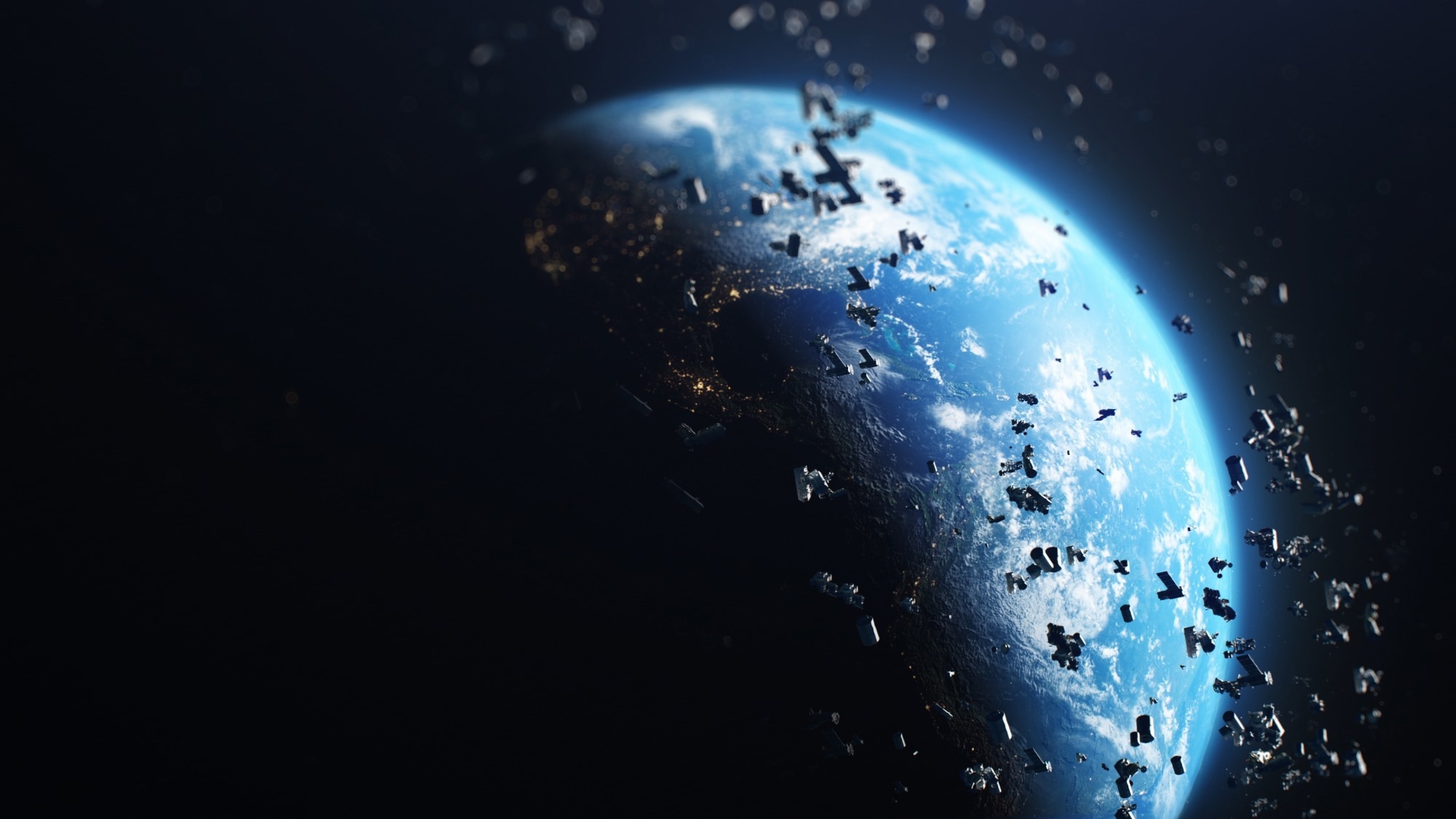
Image Credit: Frame Stock Footage/Shutterstock.com
What Is Kessler Syndrome?
Kessler syndrome describes a theoretical chain reaction in which the density of objects in an orbital region becomes high enough that collisions generate debris faster than it can be removed. As fragments accumulate, they raise the risk of additional collisions, potentially making commonly used orbits increasingly hazardous for satellites.
The concept was proposed by NASA scientists Donald J. Kessler and Burton Cour-Palais in a 1978 Journal of Geophysical Research paper. Their analysis showed that, unlike collisions in the natural asteroid belt, collisions between human-made objects in orbit could become a significant source of debris over timescales of decades. The work established the scientific basis for understanding orbital debris as a potentially self-sustaining problem.
The risk also depends strongly on orbital altitude and the characteristics of the objects involved. In lower orbits, atmospheric drag can gradually remove smaller fragments, whereas debris in higher, longer-lived orbits can remain for decades or even centuries. This means that the onset and severity of a collision cascade would vary substantially between orbital regions rather than occurring as a single, uniform event.1,2
Keep the PDF of this article here
How Could Kessler Syndrome Happen?
A collision at orbital speed behaves nothing like a crash on the ground. Objects in low Earth orbit travel fast enough that even a relatively small impact can release enormous kinetic energy, shattering both bodies into hundreds or thousands of fragments. Each fragment follows its own trajectory, creating a dispersed cloud of debris that can remain hazardous to other spacecraft.
The danger is not limited to large objects. A paint fleck or stray bolt travelling at orbital velocity can carry enough kinetic energy to puncture a fuel line, damage a solar panel, or disable a sensor. Most debris smaller than roughly 10 cm is too small for ground-based radar to track individually, which limits a satellite’s ability to detect and avoid it. Larger, cataloged objects can usually be monitored and avoided through planned maneuvers, but smaller, untracked fragments remain a persistent challenge.
The risk also varies across orbital regions. At around 550 km altitude, where many satellite constellations operate, ESA modeling suggests debris density is approaching the same order of magnitude as the density of active satellites. This makes the region particularly vulnerable to collisions, unlike less populated or lower orbits where atmospheric drag can gradually remove debris.
A debris cascade would still not occur suddenly or inevitably. Kessler and his co-authors described the process as unfolding over decades to centuries, with each collision gradually increasing the probability of another. The concern is therefore less a single catastrophic event than the slow deterioration of the orbital environment, potentially making some regions increasingly difficult and costly to use safely.2,3
Is Kessler Syndrome Already a Risk?
While it is not an immediate threat, the debris environment is showing increasingly concerning trends. The number of catalogued objects in orbit has risen from around 13,000 in 2007 to more than 40,000 today, reflecting the rapid growth of both satellite activity and debris. At the same time, models estimate that more than 1.2 million fragments larger than one centimeter remain too small to track individually, adding a largely invisible layer of risk to an already crowded orbital environment.
Active payloads in the busiest low-Earth-orbit bands have grown sharply over the past decade, with roughly a quarter of constellation satellites now operating in the lowest and most crowded altitude ranges. An increasing number of satellites are re-entering the atmosphere, yet too few are being removed from congested orbits at the end of their service lives, increasing the likelihood that close approaches will develop into collisions.
Recent events show how quickly such collisions can add to the problem. China’s 2007 test that destroyed the defunct Fengyun-1C satellite created the largest known human-made debris cloud on record. The 2009 collision between the derelict Cosmos 2251 and operational Iridium 33 has often been cited as an early real-world illustration of the collision risks underlying the Kessler Syndrome, generating thousands of debris fragments in low Earth orbit. 2,3,4
What Would Kessler Syndrome Mean for Space Technology?
A meaningfully degraded orbital environment would affect nearly every technology that depends on reliable access to space. Communications constellations, broadband satellites, Earth-observation systems, and navigation networks such as GPS all operate within specific orbital bands, where denser debris would increase the likelihood of satellite damage and make replacement missions more difficult and costly.
Scientific missions would face similar constraints. Space telescopes and Earth-monitoring instruments cannot simply relocate to a cleaner orbit without major changes to mission design, launch requirements, and operations.
Satellite-based quantum technologies could face additional challenges. For example, China’s Micius satellite, which has demonstrated quantum key distribution from around 500 kilometers, rely on precisely aligned optical components that can be particularly sensitive to vibration or damage from even small impacts. A progressively more hazardous environment could therefore complicate the deployment of future quantum communication and sensing networks in already crowded orbital bands.
For satellite operators, the consequences would extend beyond collision damage. Avoidance maneuvers would require more propellant, satellite lifetimes could shorten, insurance costs could rise, and spacecraft might need additional shielding or structural protection that increases mass and launch costs. 5,6
Individually, these effects may be manageable, but together they could make space operations progressively more expensive and constrain the development of future space-based technologies.
How Can Kessler Syndrome Be Prevented?
The most immediate defense is better awareness. Space surveillance networks and commercial tracking services provide conjunction warnings that allow operators to avoid predicted close approaches, while expanding coverage to smaller, untracked fragments remains a major priority.
Regulation is tightening around satellite end-of-life practices. The long-standing guidelines from the Inter-Agency Space Debris Coordination Committee, endorsed by the UN Committee on the Peaceful Uses of Outer Space, has called for low-Earth-orbit satellites to be deorbited within 25 years of retirement. In 2022, the US Federal Communications Commission reduced this period to five years for its licensees.3,6
These measures can limit the creation of new debris, but they cannot address the large population of objects already in orbit. Active debris removal is therefore becoming an important complement to prevention. Astroscale’s ADRAS-J mission has already inspected a derelict Japanese rocket stage at close range, with a follow-up mission selected to capture and deorbit it, while ESA is pursuing a comparable demonstration through its ClearSpace-1 mission.3,7
However, none of these measures work in isolation. Effective prevention requires international coordination through initiatives such as the Zero Debris Charter, signed by more than 20 countries and over 200 organizations, committing participants to reducing debris creation and promoting responsible practices across the entire mission lifecycle.8
The Future of Sustainable Space Operations
Keeping Earth’s orbital environment usable is not a problem that resolves itself. Current data show the debris population still growing even as compliance with mitigation guidelines improves, because fragmentation events continue to outpace natural re-entry.
Meeting that challenge will likely require sensors capable of cataloguing centimeter-scale fragments, wider adoption of shorter deorbit timelines and passivation standards across all spacefaring nations, and active removal missions that scale from single demonstrations to routine operations.
As satellite numbers keep climbing, the standards being set now by agencies, regulators, and companies will largely determine how much of near-Earth space remains usable in the decades ahead.
Nanomaterials could completely change the space tech game - we explore why here
References and Further Reading
- Mariappan, A., & Crassidis, J. L. (2023). Kessler’s syndrome: a challenge to humanity. Frontiers in Space Technologies, 4. https://doi.org/10.3389/frspt.2023.1309940
- Aerospace America. (2025). Understanding the misunderstood Kessler Syndrome. https://aerospaceamerica.aiaa.org/features/understanding-the-misunderstood-kessler-syndrome/
- European Space Agency. (2025). ESA Space Environment Report 2025. https://www.esa.int/Space_Safety/Space_Debris/ESA_Space_Environment_Report_2025
- Pardini, C., & Anselmo, L. (2023). The short-term effects of the Cosmos 1408 fragmentation on neighboring inhabited space stations and large constellations. Acta Astronautica, 210. https://doi.org/10.1016/j.actaastro.2023.02.043
- American Physical Society. (2022). Paving the way for satellite quantum communications. Physics, 15, 172. https://physics.aps.org/articles/v15/172
- Lu, C.-Y., Cao, Y., Peng, C.-Z., & Pan, J.-W. (2022). Micius quantum experiments in space. Reviews of Modern Physics, 94(3). https://doi.org/10.1103/revmodphys.94.035001
- Astroscale. (2026). Astroscale Japan Selects Isar Aerospace to Launch ADRAS-J2. https://www.astroscale.com/en/news/astroscale-japan-selects-isar-aerospace-to-launch-adras-j2
- ESA. (2022). The Zero Debris Charter. https://www.esa.int/Space_Safety/Clean_Space/The_Zero_Debris_Charter
Disclaimer: The views expressed here are those of the author expressed in their private capacity and do not necessarily represent the views of AZoM.com Limited T/A AZoNetwork the owner and operator of this website. This disclaimer forms part of the Terms and conditions of use of this website.