Durham University physicists and partners in Leiden are making one of the world’s biggest cosmology datasets available, providing scientists throughout the world with a new tool to investigate how the Universe evolves.
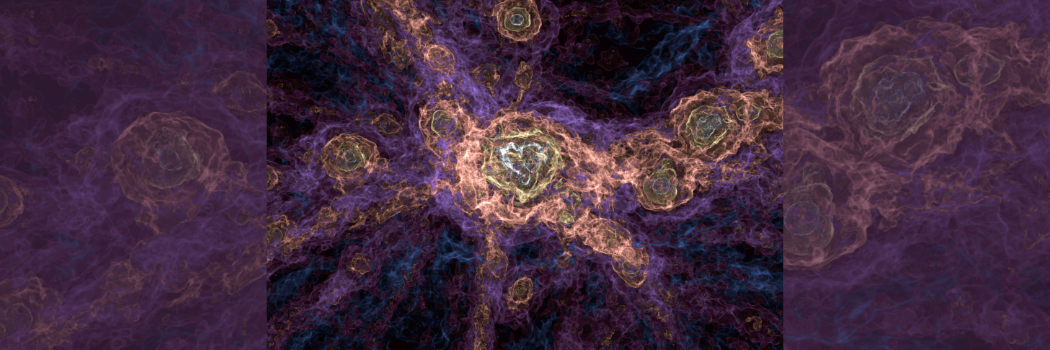 A visualization of the most massive cluster in the simulation of a cube 2.8 Gpc on a side. Colors are isodensity contours, equally spaced in logarithmic density. Image Credit: The FLAMINGO Project
The data come from the FLAMINGO project, an international collaboration that uses large-scale supercomputer simulations to study how matter evolves across cosmic time. The DiRAC Memory Intensive Service at the Institute for Computational Cosmology now provides free access to nearly 2.5 petabytes of data.
All simulations were carried out on the COSMA-8 supercomputer, which is housed at Durham as part of the UK's DiRAC national high-performance computing facility. This latest dataset release gives researchers worldwide unparalleled access to sophisticated virtual universes.
Opening New Windows on the Universe
Cosmological simulations allow scientists to study how dark and visible matter clusters and galaxies emerge across the universe. They are critical for understanding the physical processes at work in the universe and interpreting the most recent findings from major telescopes and satellites.
The FLAMINGO project combines two areas of cosmology that are often treated separately: astrophysics and particle physics. Many detailed simulations focus on relatively small regions of space to capture the complex physical processes that take place within galaxies.
However, precision cosmology requires models that cover vast volumes of space. FLAMINGO achieves both. Its simulations span billions of light-years, enabling researchers to investigate rare structures such as massive galaxy clusters while also examining the processes that drive galaxy formation.
Making Data Accessible Worldwide
The FLAMINGO team, a collaboration between the ICC and Leiden University, developed a web-based system that lets researchers access only the specific information they need from the 2.5 petabytes of data, given the scale of the dataset.
FLAMINGO has already been used by researchers to study the large-scale structure of the universe and the processes behind galaxy formation.
Now that the full dataset is publicly available, the project is expected to support many more discoveries.
.