A research team from Tohoku University, the Nara Institute of Science and Technology (NAIST), and the University of Information Technology (Vietnam National University, Ho Chi Minh City) has introduced a new framework called compilation-based quantum process tomography (CQPT). Their findings were reported in Advanced Quantum Technologies.
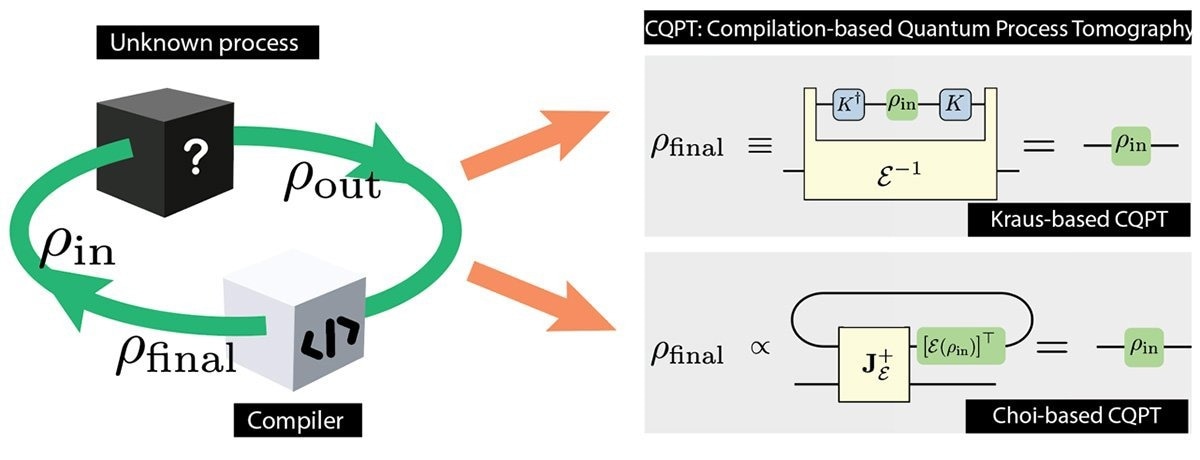 Overview of compilation-based quantum process tomography (CQPT). The left panel shows the main idea: an unknown quantum process transforms an input state into an output state, and CQPT uses a trainable "compiler" to learn the process by forcing the final state to return to the original input. The right panels illustrate two implementations of CQPT: a Kraus-based approach for unitary or near-unitary processes, and a Choi-based approach for general noisy processes. Image Credit: Le Bin Ho et al.
Quantum computers operate by applying quantum operations, such as quantum gates, to highly delicate quantum states. In theory, these systems can solve complex equations at extraordinary speeds, far beyond what conventional computers can achieve.
In real hardware, however, quantum operations often deviate from ideal behavior because of device imperfections and unwanted environmental noise. To build reliable quantum machines, researchers need accurate methods to determine exactly how a quantum device is actually performing in practice.
Quantum process tomography (QPT) is a common technique for this. Traditional QPT, on the other hand, becomes extremely expensive as the system expands because the number of needed measurements and calculations rises exponentially with the number of qubits.
The core concept of CQPT is easy. The technique begins with a known input quantum state, applies a trainable process that mimics the unknown process, and then works backwards to assess how well the final output returns to the initial input.
The “return-to-input” approach is designed to recreate the quantum processes that occur between the input and output. Importantly, the framework is constructed so that optimization can be conducted with only one measurement outcome per input state.
The researchers created two complementary versions of the CQPT: one based on Kraus operators and one based on the Choi matrix. These two techniques enable CQPT to handle a wide range of quantum operations and noisy processes that are important to current quantum devices.
Efficient and scalable methods for characterizing quantum processes are important for the future of quantum computing and quantum sensing. We need such methods to check whether quantum gates and circuits work correctly, identify hardware errors, calibrate devices, and support quantum error correction.
Le Bin Ho, Assistant Professor, Tohoku University
Dr. Le believes that CQPT could grow into a viable alternative to normal quantum process tomography, particularly for bigger quantum systems where complete tomography is no longer feasible due to high costs.
The current study shows that CQPT is viable using sound theoretical analysis and numerical simulations. The concept is a viable approach to improving quantum tomography efficiency. The next stage will be to tackle the problem of applying it in real-world trials. The researchers intend to work on creating hardware-ready versions of the approach and strengthening its resilience.
Sources:
Journal Reference:
Linh, H. L. D. et.al. (2026) Advancing Quantum Process Tomography Through Quantum Compilation. Advanced Quantum Technologies. DOI: 10.1002/qute.202500494. https://advanced.onlinelibrary.wiley.com/doi/10.1002/qute.202500494.
Tohoku University