Quantum computing promises a new era of computational power, with major implications for fields like drug discovery, artificial intelligence, cryptography, and complex simulations. But one of the biggest hurdles remains: how do we scale quantum systems to support thousands – or even millions – of qubits?
Silicon photonics could offer a path forward. By using light instead of electrons to process and transmit information, this technology introduces the efficiency and scalability that quantum computing desperately needs.
This article explores what silicon photonics is, why it matters, and how it could influence the next generation of quantum processors.
Understanding Silicon Photonics
Silicon photonics integrates light-based (photon) components directly onto silicon chips. Instead of relying on electrical signals, these chips guide and control photons through microscopic optical circuits.
Key advantages include:
- High bandwidth – Photons can carry far more data than electrons.
- Low energy loss – Photons don’t create resistive heat, reducing energy waste.
- Parallel processing – Multiple wavelengths of light can travel the same path, enabling highly parallel data transmission.
- CMOS compatibility – Silicon photonics can be manufactured using existing semiconductor fabrication methods.
By combining the optical benefits of light with the mature infrastructure of silicon manufacturing, silicon photonics is already driving change in telecom, data centers, and AI hardware – and now it's set to impact quantum computing in a similar way.
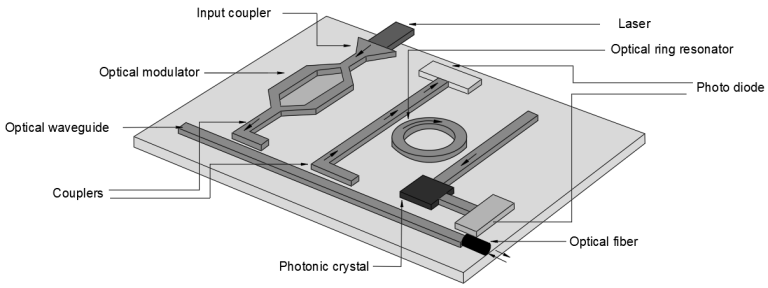
Diagram of a silicon photonics chip with integrated optical waveguides for quantum computing. Image Credit: Avantier Inc.
Silicon Photonics in Quantum Computing
Quantum computing faces three core scaling challenges: noise, interconnect complexity, and cooling demands. Silicon photonics offers promising solutions to each.
1. Low-Noise Qubit Transmission
Photons are naturally resistant to environmental noise, helping reduce decoherence and enabling reliable quantum communication over longer distances.
2. Scalable Interconnects for Quantum Chips
Traditional electrical wiring struggles to support thousands of qubits. Optical waveguides, however, can provide dense, low-loss connections – even across multiple chips.
3. Room-Temperature Operation
Many photonic systems can operate at or near room temperature. This reduces the need for cryogenic cooling in hybrid quantum architectures.
4. Integration with Classical Electronics
Because silicon photonics is CMOS-compatible, it can be integrated with classical control logic and error correction circuits – critical for building real-world quantum systems.
Where It’s Being Used: Applications in Quantum Technology
Silicon photonics is already finding its way into several key areas of quantum computing:
- Photonic quantum computers – These systems encode quantum data directly into photons and manipulate it using optical components like waveguides and phase shifters.
- Quantum interconnects – Photons act as "flying qubits," linking modular quantum processors and enabling more scalable designs.
- Quantum networks and communications – Compact silicon chips are being developed for secure quantum key distribution (QKD), opening the door to practical quantum internet infrastructure.
Remaining Challenges
As promising as it is, scaling silicon photonics for quantum computing comes with technical hurdles:
- Single-photon sources – Generating identical, on-demand photons at scale remains difficult.
- Chip integration – Merging optics and electronics on a single chip introduces fabrication and thermal challenges.
- Error correction – Quantum error correction is still resource-intensive, even when using photonic approaches.
Electronics vs. Photonics: A Comparison
Understanding the contrast between traditional electronics and photonics underscores why silicon photonics is getting so much attention in the quantum space.
Data Comparison: Electronics vs. Photonics in Computing. Source: Avantier Inc.
| Feature |
Electronics (Copper-Based) |
Photonics (Light-Based) |
Advantage |
| Signal Carrier |
Electrons |
Photons (light particles) |
Photonics – faster and interference-free |
| Transmission Medium |
Copper wires or metal interconnects |
Optical waveguides or fibers |
Photonics – higher density and distance |
| Bandwidth Capacity |
Limited (~GHz range) |
Extremely high (~THz range) |
Photonics – vastly greater bandwidth |
Energy
Efficiency |
High resistive losses, generates heat |
Minimal loss, no resistive heating |
Photonics – lower power consumption |
| Scalability |
Limited by crosstalk and heat dissipation |
Easily parallelized via wavelength-division multiplexing |
Photonics – better scalability |
| Data Speed |
Electrical signal (~108 m/s) |
Speed of light in medium (~2×10⁸ m/s) |
Photonics – faster signal propagation |
| Noise Susceptibility |
High (EM interference) |
Very low (weak photon interaction) |
Photonics – improved signal fidelity |
Integration
with CMOS |
Mature, standard fabrication |
Increasingly compatible via silicon photonics |
Tie – both CMOS integrated |
| Cooling Requirements |
Requires significant cooling |
Often operates at room temperature |
Photonics – reduced cooling overhead |
| Use in Quantum Computing |
Limited – noise and wiring constraints |
Ideal – low-noise qubit links and scalable networks |
Photonics – key to quantum scalability |
The Future of Quantum Computing Looks Photonic
Throughout history, light has often replaced electrons when speed and scale matter – think fiber optics replacing copper or lasers redefining data storage. Quantum computing may be the next domain to follow that trend.
Silicon photonics brings together energy efficiency, scalability, and proven manufacturing compatibility. That makes it a strong candidate for powering everything from secure quantum communications to next-generation quantum processors and networks.
Acknowledgments
Produced from materials originally authored by Avantier Inc.

This information has been sourced, reviewed, and adapted from materials provided by Avantier Inc.
For more information on this source, please visit Avantier Inc.