Alice & Bob and Thales announced today a partnership to develop quantum algorithms capable of accelerating the simulation of aerospace equipment, such as radar or telecommunications antennas.
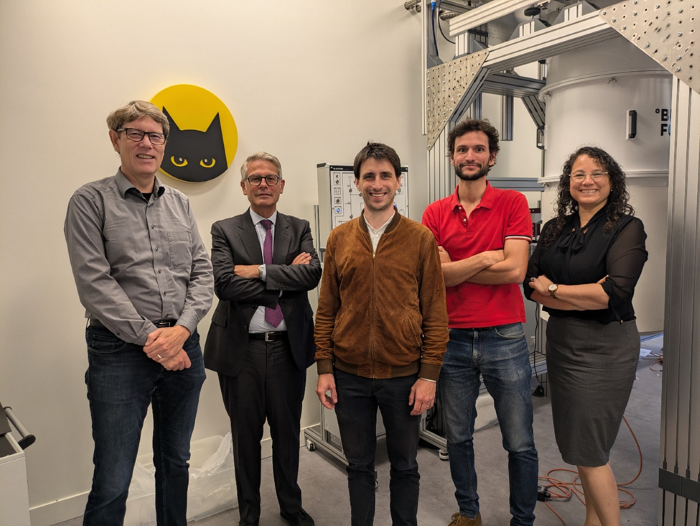 From left to right: Bernhard Quendt (Global CTO Thales), Frederic Barbaresco (Segment Leader of Key Technology Domain PCC (Processing, Control & Cognition) Thales) Theau, Raphael, Cécile Perrault (Head of Partnerships, Alice & Bob. Image Credit: Alice & Bob
These algorithms will be developed for the new generation of “error resilient” quantum computers, known as FTQCs (Fault Tolerant Quantum Computers). Quantum computers can be classified as analog, noisy or fault tolerant. In line with the French government's recommendation that priority should be given to the latter, Alice & Bob and Thales are today joining forces to make France a frontrunner in the development of mature quantum technology.
The project evaluates whether these computers will be able to exponentially accelerate electromagnetic simulations, opening the door to the optimization of airborne equipment designs for the aerospace industry.
It will also assess accurately what resources will be needed, and therefore give a timeline on the time when quantum computers will be available to achieve this. Alice & Bob and Thales will work on the development of quantum algorithms for advanced electromagnetic simulation then test them on airborne equipment, such as radars and antennas. This will make it possible to estimate the exact number of qubits needed to industrialize and scale up these solutions.
The i-Démo Régions project, part of the France 2030 plan, has a budget of 2.6 million euros over 3 years, and has been accredited by the Systematic competitiveness cluster in the Paris region.
“The pursuit of this project demonstrates that our organizations are committed to being world leaders in quantum computing and understand how to do it,” said Théau Peronnin, CEO of Alice & Bob. “By sponsoring the development of fault-tolerant quantum computers with high-quality qubits, France will position itself to reap the first fruits of quantum tech.”
"This cooperation builds on the complementary expertise of Alice & Bob and Thales," said Bernhard Quendt, Chief Technology Officer of Thales, during his visit to Alice & Bob's headquarters in Paris. "Our combined expertise will enable technological advancements in aerospace."
This unprecedented cooperation draws on the synergistic know-how of Alice & Bob and Thales, with the support of Inria. Inria will develop and supply the programming and compilation tools for the quantum algorithms, which will be adapted and implemented by Alice & Bob on their FTQC quantum calculator demonstrators. Thales will define the use cases, benchmark the algorithms and test their performance.